
Telling the stories: women and water in Binga District
By Dr. Wendy Kroeker and Hannah Janzen, Research Assistant
"Tell the stories." This was the advice that Agree Dube, Program Manager for MCC Zimbabwe gave to us during a recent visit to Binga district, Zimbabwe. We were back in the car, having just visited a village borehole with several community members. After witnessing the challenges community members face in accessing water, we sat processing the heaviness of what had been shared and grappled with how not to let these experiences end as stories only to be documented and moved on from.
"Tell the stories."
We were being invited to tell the stories of what we saw and heard—both the hardships alongside the resilience—with people back where we call home, in Canada.
We were in Zimbabwe working on a research project looking at climate stress and its impacts on relationships. Through conversations with community members, we learned that the impacts of climate stress on relationships are most noticeable while carrying out daily tasks such as fetching water. These everyday tasks are points of tension for relationships within the community, while also providing opportunities for creative adaptation and community cooperation in the face of shared challenges. After one of our workshops, some participants had invited us to visit the borehole where their community gets its water. The borehole is a central community hub and daily meeting place for women, and the community members showed us the realities of their challenges accessing water and shared stories of how they have come together to address them. Since our visit to the borehole and conversation with Agree on that bumpy Binga road, we've been thinking about the importance of storytelling in creating change.
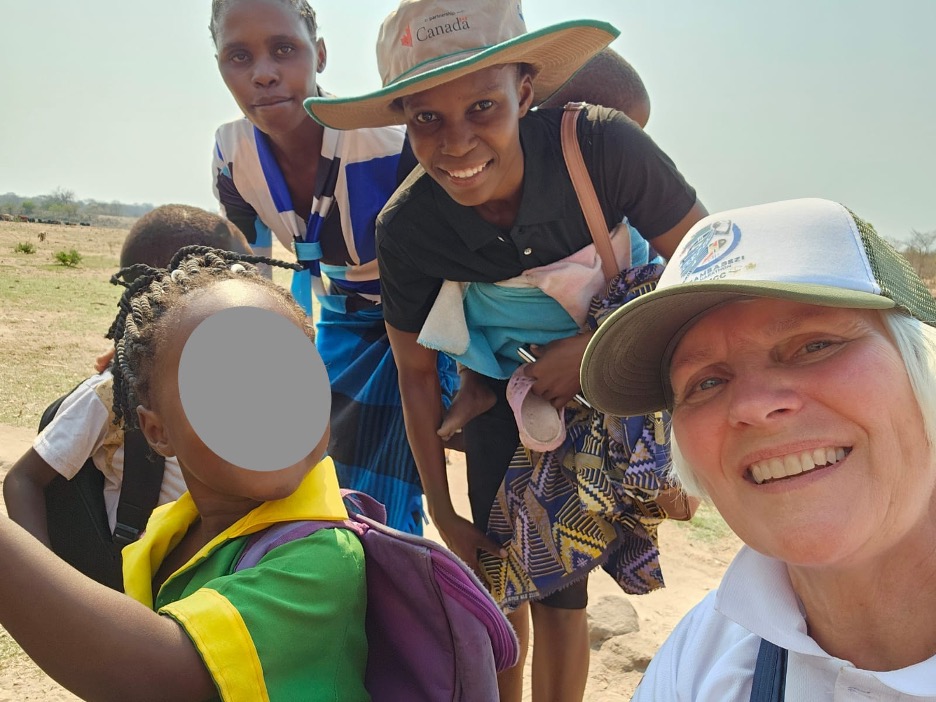
Photo by Wendy Kroeker, 2025.
Stories breathe life into an issue, transforming abstract challenges into personal experiences felt by a particular person or community. This connection inspires action, as listeners begin to see themselves in the narrative. This photo essay tells the story that Agree encouraged us to share: the story of several women living in Binga district's Saba/Lubanda Ward. One of these women, a workshop participant (pictured above), is named Sympathy Mola.
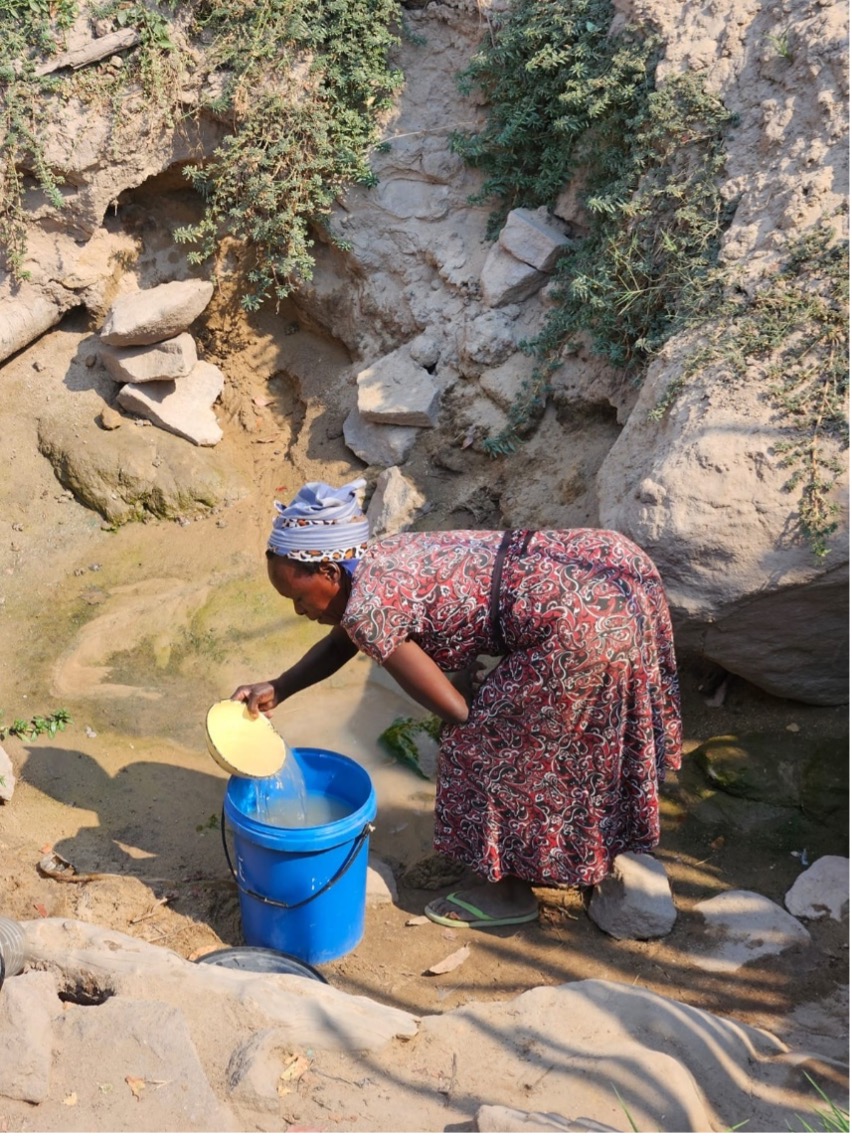
Photo by Wendy Kroeker, 2025.
Pictured here is the borehole we visited in the Saba/Lubanda Ward in Binga district. The water table in Binga is very low, meaning that many boreholes don't hold much water and have to be drilled very deep to reach water. Getting water is hard physical work. Women must climb down into the borehole and back up again carrying full buckets, and Sympathy shared that it can take up to 45 minutes to fill one single bucket because the water trickles slowly and has to recharge after every few scoops.
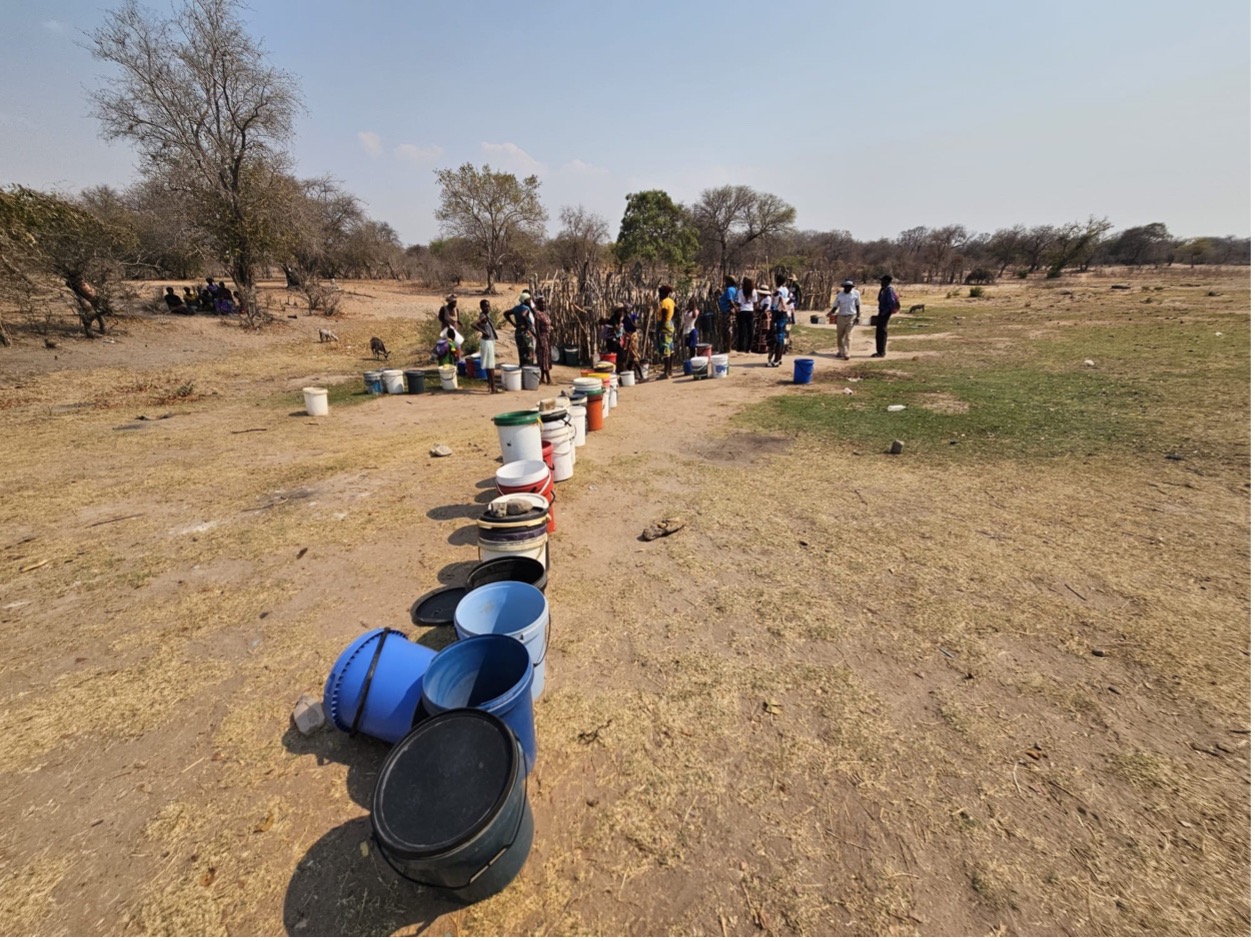
Photo by Wendy Kroeker, 2025.
Since it takes so long to fill their buckets, the queue for accessing water is long. This photo shows the line-up of buckets when we visited the borehole at 2:00 in the afternoon. Despite arriving at 8:00 that morning, Sympathy's buckets were still in the middle of the queue when this photo was taken. She estimated her turn to collect water would come between 11:00 p.m. and midnight. Understandably, Sympathy plans her days around getting water. She visits the queue in the afternoon to check where she is in line before bringing her two young children home and cooking them dinner. She returns to the borehole to finally fill her buckets at night.
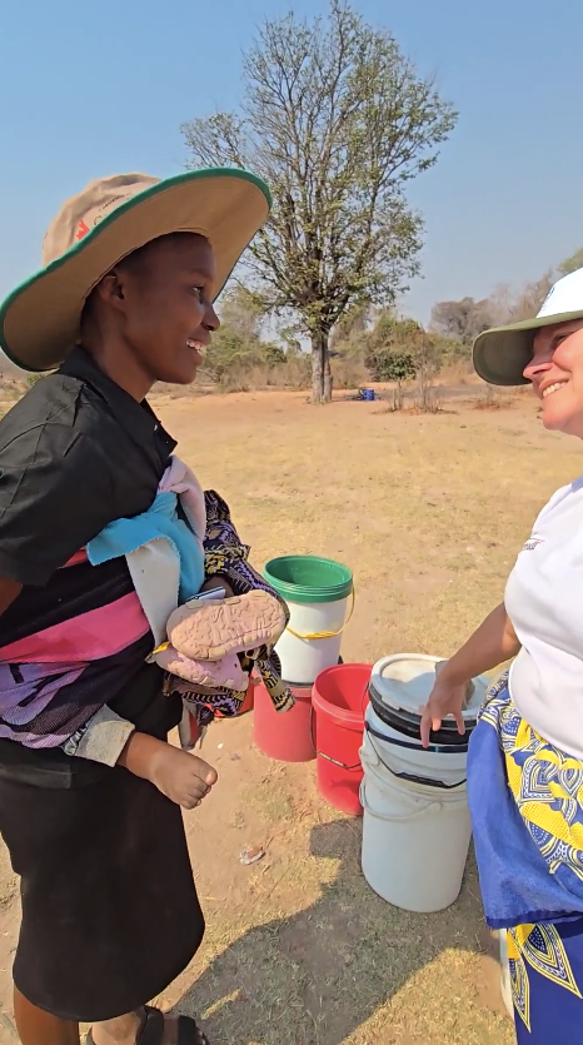
Photo by Hannah Janzen, 2025.
By the time Sympathy finishes getting water, it's 11:00 p.m., and she still has the five-kilometer walk home in the dark. We asked if she's ever afraid. "Yes," she told us, "I am so scared." Walking at night increases the risk of encountering dangerous animals or experiencing gender-based violence (Desai and Mandal 2021; Gomo, Muchenje and Zaranyika 2025). Yet for many women, this risk is unavoidable if they wish to have water available at the start of the next day.
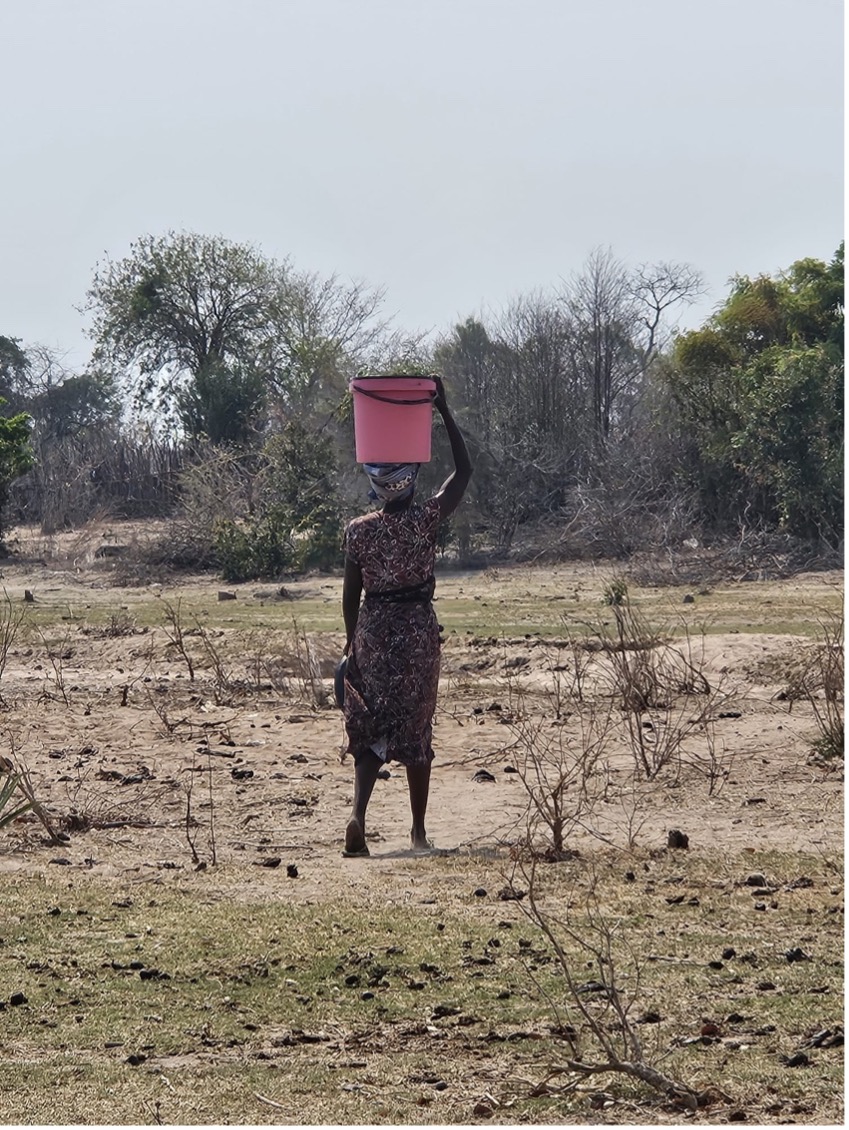
Photo by Wendy Kroeker, 2025.
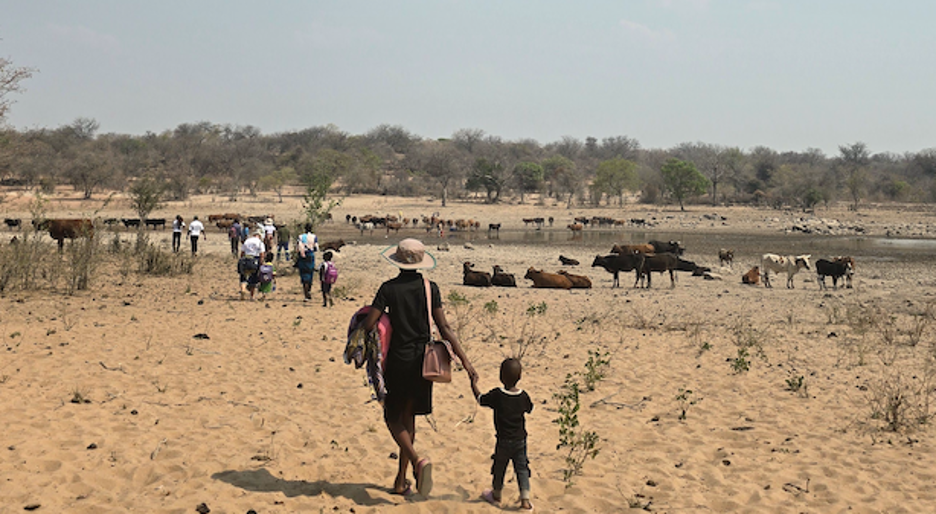
Fetching water often means walking long distances because of the limited number of boreholes. Women carry the full buckets home on their heads. Sympathy makes three trips for her three buckets, carrying one at a time. Other women choose to carry all the three at once: one on the head and one in each hand. Some women must walk up to 10 kilometers one way just to reach water, and they told us about the health challenges these trips create—many women experience back, neck, and leg pain (Gomo et al. 2025). For Sympathy, who walks five kilometers each direction, three trips a day adds up to more than 30 kilometers traveled daily.
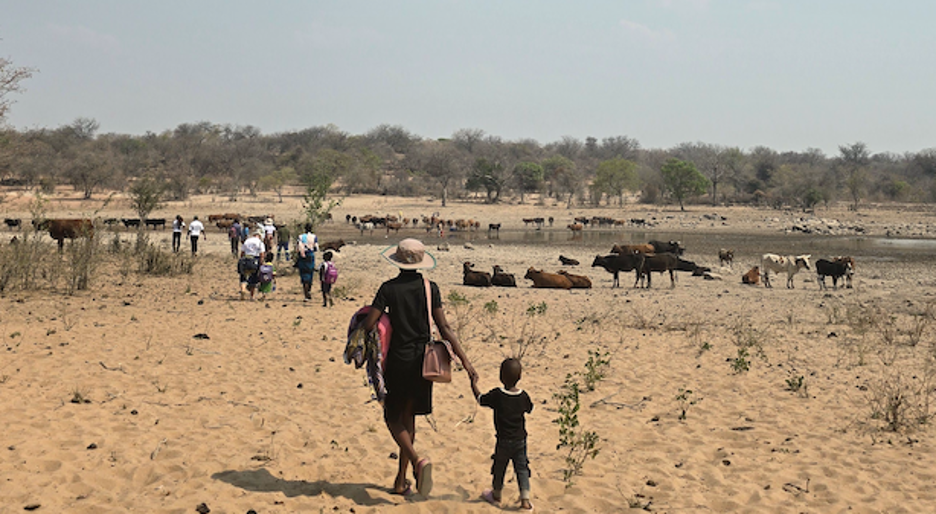
Photo by Hannah Janzen, 2025.
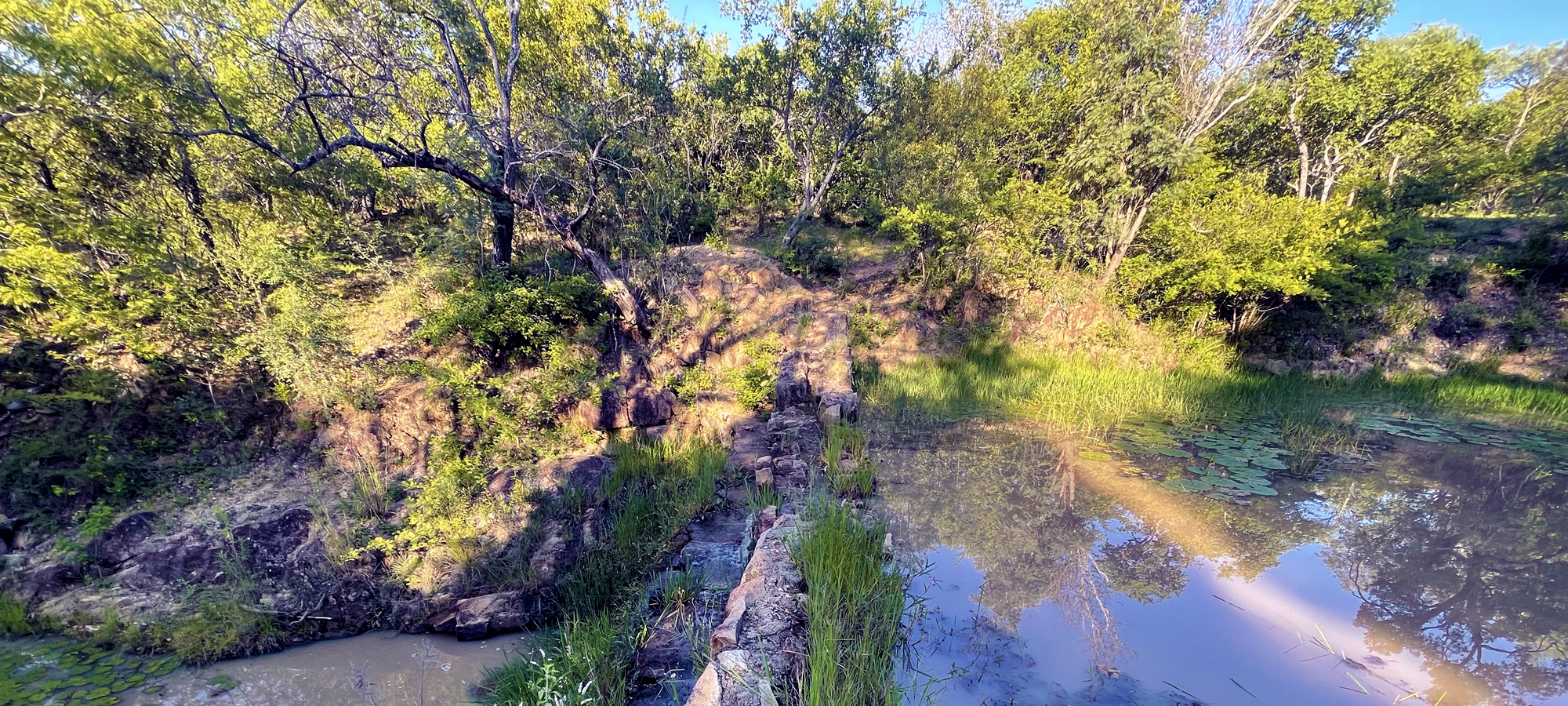
Sympathy also showed us this pond where livestock drink and bathe (featured above). The pond is only a few hundred meters away from the borehole, which is close enough for the contamination from the livestock to affect the quality of water in the borehole. With water so limited, there's competition between people and livestock for access. Sympathy said the community is in the process of working on strategies to move the livestock to a different water source.
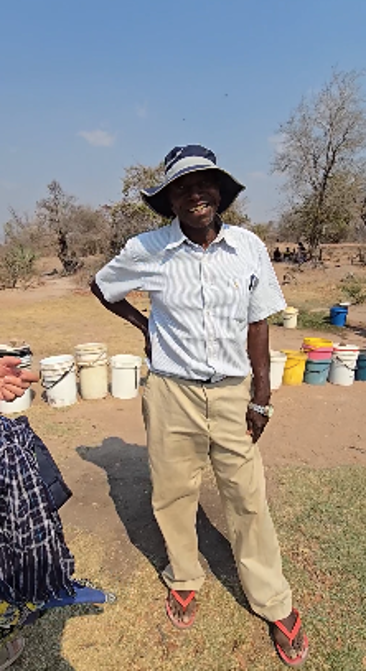
Photo by Hannah Janzen, 2025.
With water so scarce, the community has had to work together to manage access. Sympathy told us that women used to arrive with 15 buckets at a time—one household's buckets could drain nearly the entire borehole for the day, leaving everyone else to wait until the next day once the borehole had replenished. This created tension and arguments among the women waiting in line.
So, the community sat down together. Village head Moses B. Mugombe (pictured above) explained that they came to an agreement that each household could fill four buckets per day. As the water table has dropped, this limit has since been reduced to three. Sympathy described how this system has helped reduce community tensions while ensuring that every household has equitable access to water.
Photo by Hannah Janzen, 2025.
After our visit to the borehole, Sympathy asked if she could trade "Zambia" skirts with Hannah. Hannah was happy to oblige, and the fabric wrap skirts, commonly worn over pants, were readily exchanged. This Zambia now hangs in Hannah's closet in Canada, a tangible reminder of Sympathy's story and the moments of connection we shared at the borehole.
Sympathy was honest with us about her challenges and fears. She wishes for better, safer access to water. Walking with her to the borehole, holding her child's small hand, we were reminded that these are not distant problems. Sympathy's story is one small window into a much larger reality. For her, fetching water is more than just turning a tap—it is waiting long hours in the queue, and carrying heavy buckets while walking long-distances at night. Her story stays with us as a call to pay attention to the choices we make, the systems we're part of, and the work that remains.
With Agree's encouragement, we have been sharing Sympathy's story when we can—in the classroom and at family gatherings—hoping to call others to attention. Not just to Sympathy's situation, but to our own connections to it. Because the truth is, the low water table in Zimbabwe's Binga district is not separate from the world we all share. The same global pressures that influence water availability in Binga such as climate change, environmental degradation, and the unequal use and access to resources are shaped by choices made far beyond Sympathy's community.
When you and I, living in Canada, are intentional about how we use water, or find ways to repurpose things instead of buying new, we're acknowledging that our daily habits are part of a much larger environmental picture—one that reaches places like Saba/Lubanda Ward, where women like Sympathy walk kilometers in the dark for water.
Acknowledgements
We are deeply grateful to the staff at Kulima Mbobumi Training Centre, MCC Zimbabwe, the community leadership, the women of Saba/Lubanda Ward, and of course, Sympathy Mola for trusting us with their stories and sharing their time so generously during our visit.
Sources
Desai, Bharat H., and Moumita Mandal. 2021. "Role of Climate Change in Exacerbating Sexual and Gender-Based Violence Against Women: A New Challenge for International Law." Environmental Policy and Law 51 (3): 137-157. https://doi.org/10.3233/EPL-210055
Gomo, Manford Takudzwa., Andrew Muchenje and Zano Brandon Zaranyika. 2025. "Gendered Climate Change-Induced Domestic Water Challenges: Exploring the Plight of Women and Girls Linked to Water Challenges in Ward 32 of Buhera District, Zimbabwe." International Journal of Research and Innovation in Applied Science 5 (2): 359-365. https://doi.org/10.51584/IJRIAS.2025.10020031
 Print This Blog Post