
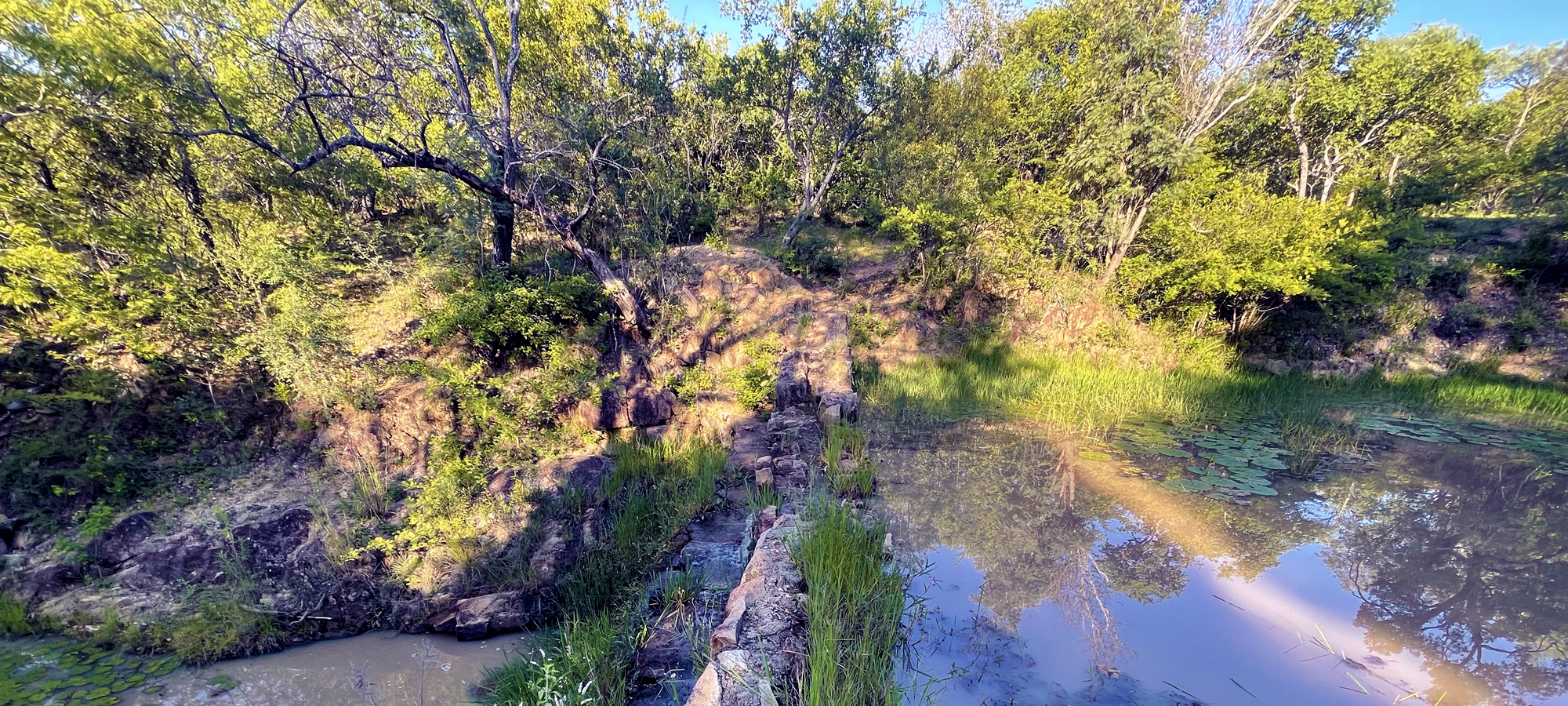
Dwindling natural safety nets: the impact of mopane worm decline on food security and livelihoods
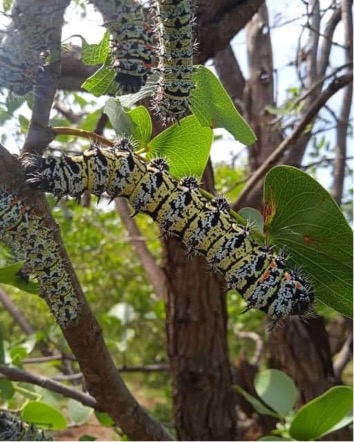
By Ntuthuko Ngwenya (MCC Zimbabwe)
The "butterfly" lifeline
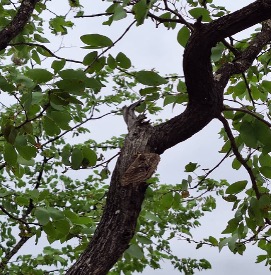 Mopane worm butterfly (emperor moth) in a mopane tree in Mwenezi district. Photo by Ntuthuko Ngwenya (MCCZ).
In the parched landscapes of Gwanda and Mwenezi, where the dry soils of southern Zimbabwe meet an unforgiving sun, one tree stands as a silent guardian of survival: Colophospermum mopane. Commonly known in English as mopane, this native tree with distinctive butterfly-shaped leaves is not merely a national botanical feature; it is a "natural safety net" for thousands of households.
The mopane tree is the primary host of the emperor moth's larvae. The emperor moth is known locally in the Ndebele language as 'Amacimbi', as 'Madora' in the Shona language, and colloquially in English as 'mopane worm'. Mopane worms (Imbrasia belina) are a highly nutritious and affordable source of protein for rural households in Mwenezi and Gwanda. For many families, these worms are a reliable substitute for costly animal protein and are an essential component of local diets.
Although the harvesting and marketing of mopane worms has long been a reliable source of income for many, in recent years this lifeline has been fraying. Recent ecological assessments and community observations point to the steady decline in mopane woodland density and health across Matabeleland South (Gwanda) and Masvingo provinces (Mwenezi).
This article explores how the degradation of mopane woodlands is dismantling household food security and eroding the legendary resilience of communities in these semi-desert districts of Zimbabwe.
The mopane economy: more than a tree
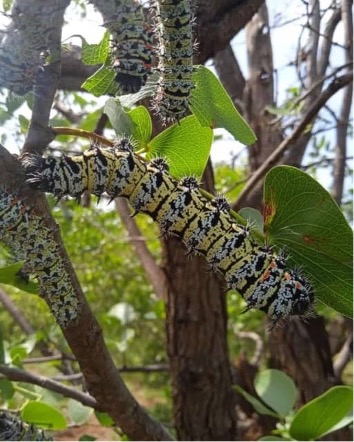 Mopane worms feeding on the Mopane tree in Gwanda. Photo by Ntuthuko Ngwenya (MCCZ).
Zimbabwe's Gwanda and Mwenezi districts fall in agro-ecological regions IV and V, zones characterized by high temperatures and low rainfall. Communities in these districts rely on rainfed agriculture with highly variable crop yields and frequent crop failure. Mopane woodlands have long contributed to diversified ecosystem services that have sustained rural life in these regions.
Zimbabwe's Gwanda and Mwenezi districts fall in agro-ecological regions IV and V, zones characterized by high temperatures and low rainfall. Communities in these districts rely on rainfed agriculture with highly variable crop yields and frequent crop failure. Mopane woodlands have long contributed to diversified ecosystem services that have sustained rural life in these regions.
With the economic situation getting more unpredictable each day, especially for the rural communities, availability of mopane worms has become an economic buffer. The harvesting, processing, and trading of mopane worms provide much-needed money for household economies. This income is often used to pay school fees, cover healthcare costs, and purchase agricultural inputs.
Mopane woodlands also support livestock-based livelihoods. During prolonged and grueling dry seasons, mopane leaves retain relatively high nutritional value even after falling from the tree. These leaves serve as an important source of fodder for cattle and goats, which represent the primary store of wealth for many rural households. In this way, mopane ecosystems sustain both human and livestock survival during periods of extreme stress.
Drivers of decline: a perfect storm
The decline of mopane woodlands is not driven by a single factor, but by the interaction of multiple climatic and human pressures. Although mopane trees are naturally drought-tolerant, the increasing frequency of prolonged droughts and extreme heat in Gwanda and Mwenezi exceeds the species' physiological limits. Reduced leaf biomass, poor regeneration, and declining seed viability are becoming more common as climate stress intensifies.
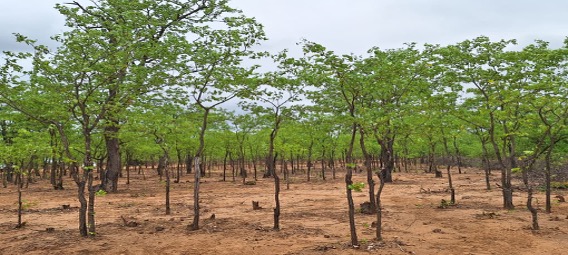
One of the deforested mopane woodlots in Mwenezi. Photo by Ntuthuko Ngwenya (MCCZ).
At the same time, Zimbabwe's ongoing economic crisis has pushed more people to rely on mopane-based livelihood activities. In the absence of effective regulations, unsustainable harvesting practices, such as removing entire branches or felling live trees to access worms, are undermining natural regeneration and accelerating woodland degradation. These pressures are further compounded by a growing fuelwood crisis. With electricity unreliable and alternative energy sources unaffordable, mopane has become a preferred source of firewood and charcoal, resulting in localized "rings of deforestation" around business centers in Gwanda and Mwenezi.
Land-use change is also playing a significant role. The expansion of mining activities, settlements, and agricultural land continues to drive the clearance of primary mopane woodlots, fragmenting ecosystems that are already under severe stress.
Impacts on food security and livelihood resilience
As this natural safety net thins, household vulnerabilities in Gwanda and Mwenezi become increasingly exposed. Women, who are central to the harvesting, processing, and trading of mopane products, are particularly affected as nearby mopane sources disappear. As a result, they must travel longer distances into remote areas, increasing labor demands and exposure to physical risks, wildlife encounters, and exhaustion. This, in turn, means that households that once relied on a reliable supply of dried mopane worms as a year-round food reserve now face seasonal nutritional deficits, particularly affecting nutritionally vulnerable community members, such as children.
The erosion of mopane-based livelihoods has also weakened traditional coping mechanisms. Historically, mopane worm harvesting acted as a form of insurance during periods of crop failure. As this option diminishes, households are increasingly forced into distress sales of livestock at reduced prices to purchase grain, pay school fees, and meet daily needs. These sales permanently strip households of productive assets, deepening poverty and reducing their capacity to recover from future shocks.
Moving forward: from survival to stewardship
Despite these mounting challenges, the decline of mopane woodlands is not inevitable. Targeted activities underway through the LINCZ project in Gwanda and Mwenezi are showing how this critical safety net can be restored through deliberate, community-led intervention.
Looking ahead, the restoration of the mopane safety net requires a deliberate shift from short-term exploitation to long-term stewardship, a transition currently being championed by the LINCZ project. By strengthening community-based natural resource management (CBNRM), local leadership is empowered to enforce regulated harvesting seasons and prohibit destructive practices such as the felling of live trees.
These efforts are complemented by Farmer-Managed Natural Regeneration (FMNR), through which dedicated plots and woodlots allow communities to lead ecological recovery firsthand. To further alleviate pressure on mopane woodlands, the expansion of solar-powered drying facilities for mopane worm processing offers a practical technological alternative, reducing reliance on mopane firewood traditionally used during drying. When integrated with silvopastoral systems that harmonize tree regeneration with livestock production, these interventions help ensure that conservation and livelihood sustenance are mutually reinforcing. By combining traditional ecological knowledge with these modern tools, the LINCZ project is transforming mopane from a vanishing resource into a resilient foundation for future generations.
In conclusion, the decline of mopane woodlands in Gwanda and Mwenezi represents far more than an environmental concern; it signals the unraveling of a critical natural safety net that has sustained communities through decades of climate variability and economic hardship. As mopane trees disappear under the combined pressures of climate stress, unsustainable harvesting, fuelwood extraction, and land-use change, households that depend on them face widening protein gaps, eroded livelihood options, and diminished resilience.
Women bear a disproportionate burden, traveling farther and facing greater risks as nearby resources vanish. Yet this trajectory is not irreversible. The LINCZ project demonstrates that through community-led stewardship, Farmer-Managed Natural Regeneration, regulated harvesting, and innovative technologies like solar drying, mopane ecosystems can be restored. The path forward requires a fundamental shift from short-term extraction to long-term ecological and economic sustainability—transforming mopane from a fading lifeline back into a resilient foundation for food security, livelihoods, and the future of rural communities in southern Zimbabwe.
Ntuthuko Ngwenya is a natural resources management professional based in Zimbabwe with an MSc in Disaster Management and BSc in Natural Resources Management and Agriculture. He has an extensive experience in leading climate resilience projects for international organizations. Currently, he serves as a climate change adaptation technical officer for Mennonite Central Committee, based in Zimbabwe. This is where he specializes in implementing nature-based solutions and conservation agriculture to support vulnerable communities in Zimbabwe. As a certified remote pilot (drone operator), he focuses on bridging Indigenous knowledge with scientific innovation to build sustainable resource management systems across Zimbabwe.
 Print This Blog Post